


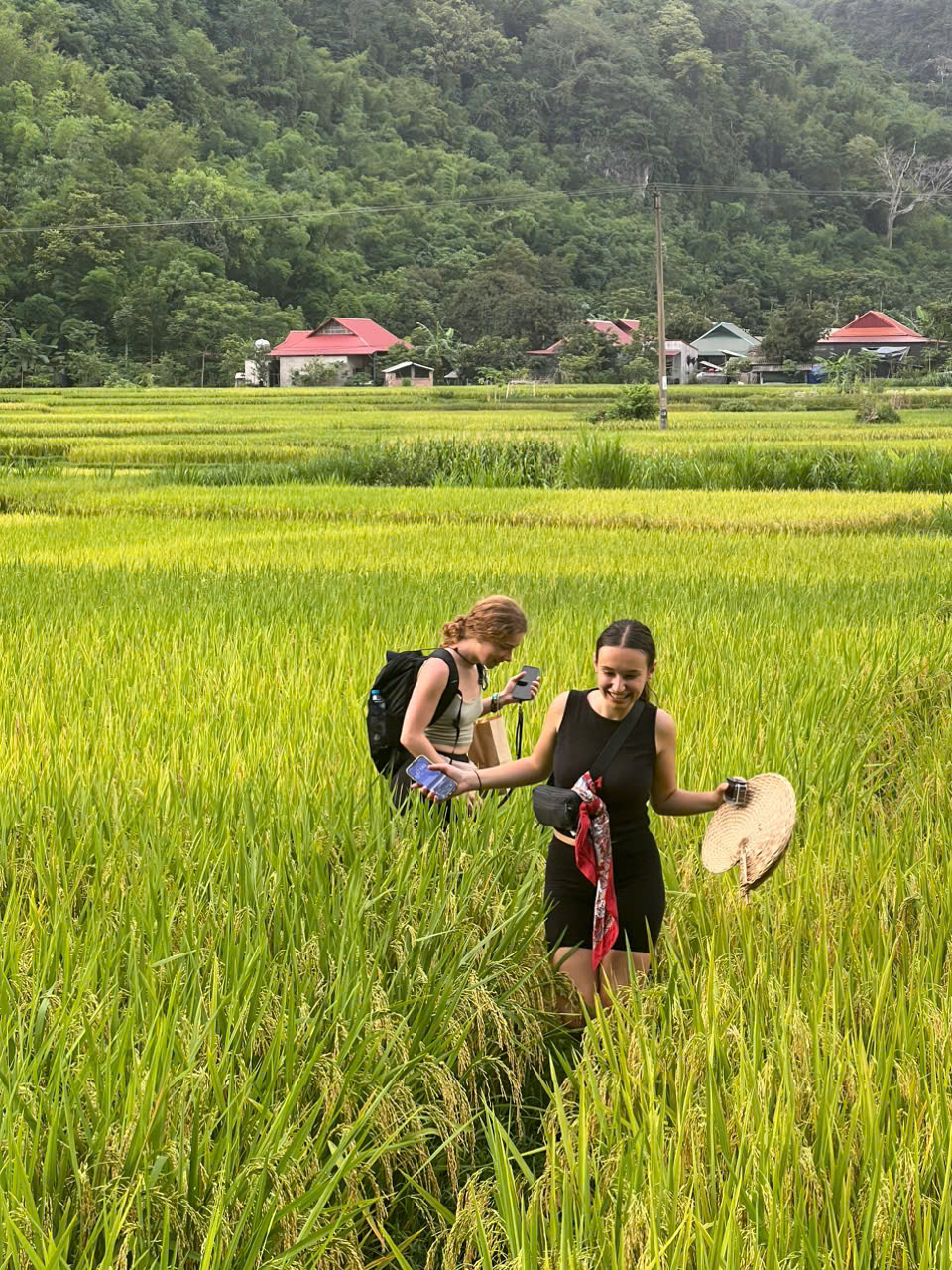
There is a moment on a Pu Luong rice planting season trek that most people are not prepared for. You come around a bend in the trail, the bamboo opens up, and below you — spread across the valley floor and climbing the hillsides in careful steps — are flooded rice terraces reflecting the sky like a thousand small mirrors.
If the light is right and the mist is still on the mountains, it looks like the whole valley is floating.
This is Pu Luong in the planting season. And it is one of the most visually stunning times to trek anywhere in northern Vietnam — not just because of the scenery, but because of what is happening in it. The Thai and Muong farmers who have shaped this landscape over centuries are out in the fields, knee-deep in water, transplanting seedlings by hand. The water buffalo are working. The valley is fully alive.
This guide covers everything you need to know about trekking in Pu Luong during the rice planting season — what you will see, what the experience feels like, and how to make the most of it.
Why the Rice Planting Season Makes Pu Luong So Special
Pu Luong is a destination worth visiting at any time of year. But the rice planting season changes the character of the valley in a way that is hard to explain until you see it.
Rice farming is not a backdrop in Pu Luong — it is the central activity that has shaped everything here: the terraces cut into the hillsides over generations, the water channels that carry irrigation down from the mountains, the rhythm of daily life in the Thai and Muong villages. When planting season arrives, that activity comes to the surface. The fields fill with water. Families move out of their homes early in the morning to work. The landscape that looked quiet suddenly has people in it everywhere.
For a trekker walking through this, the effect is immersive in a way that the golden harvest season — beautiful as it is — is not quite able to match. Planting season feels urgent and alive. The colour of the water in the paddies shifts from silver to gold to deep blue depending on the angle of the light and the time of day. The reflections of the mountains and the sky in the flooded fields are extraordinary.
And then, over the weeks that follow, the water recedes as the seedlings take root and begin to grow — and the silver of the flooded fields slowly gives way to one of the most saturated greens you will ever see.
Why the Rice Planting Season Makes Pu Luong So Special
Understanding Pu Luong’s Two Rice Crops — and Why It Matters for Trekkers
One of the most distinctive features of Pu Luong’s agricultural landscape is that the valley produces two rice crops every year. Most visitors do not know this, and it changes the way the fields look across the calendar in ways that are worth understanding before you plan your trip.
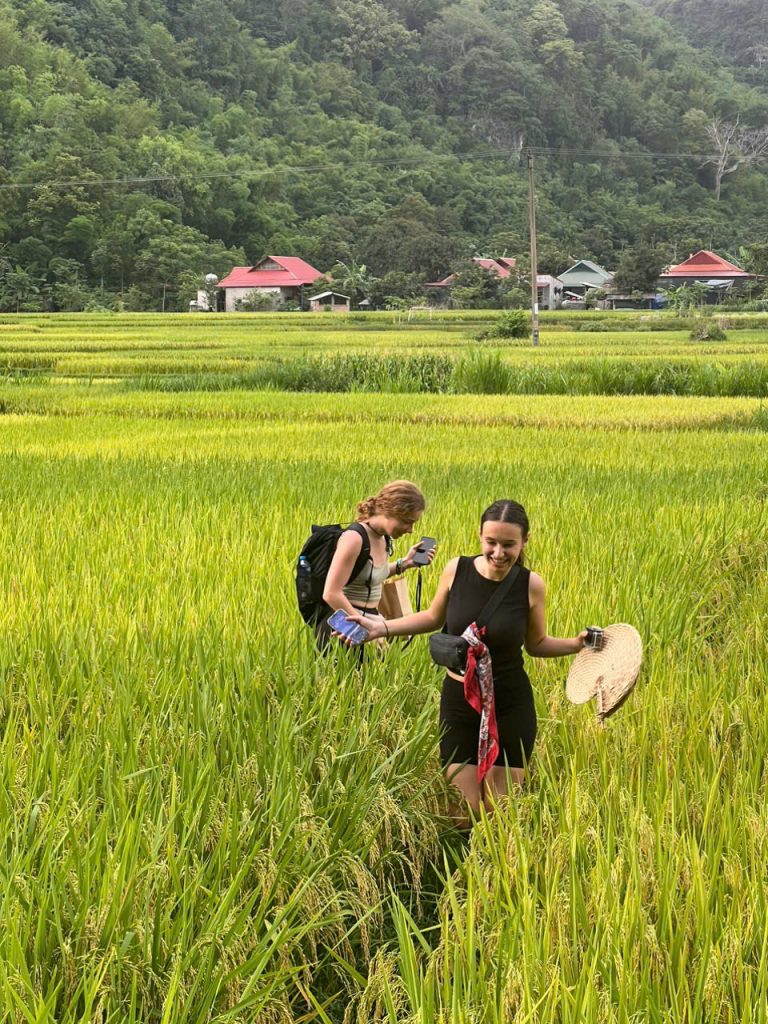
The two crops do not follow an identical schedule, and — this is the part that makes Pu Luong genuinely unique — the rice in the valley and the rice on the mountain terraces often run on slightly different rhythms. This means that at certain times of year, you can be standing on a trail in Pu Luong and see terraces at completely different stages simultaneously: golden and ready to harvest in one field, still green and growing in the next, and freshly flooded and mirrored just below.
That layered visual — multiple stages of the rice cycle visible in a single glance — is something you cannot find at most rice terrace destinations in Vietnam, where the crop timing is more uniform. It is one of Pu Luong’s genuine natural assets, and a Pu Luong rice planting season trek is one of the best ways to experience it.
Here is how the rice calendar in Pu Luong breaks down across the year:
- November to March: The fields rest between crops. Buffalo roam the fallow paddies. The landscape is open and quieter. This period also returns briefly in June, after the first crop harvest ends and before the fields are reflooded for the second cycle.
- March to mid-April and July: Planting season. The paddies are flooded with water — the mirror season, when the terraces reflect the sky and the mountains above them. This is one of the most photographed and most breathtaking states of the Pu Luong landscape.
- Mid-April to mid-May and August to September: The rice is growing. Vivid green seedlings cover the terraces, and combined with the primary forest and jungle on the surrounding mountains, the entire valley becomes a landscape of overlapping shades of green.
- Mid-May to June and October to early November: Harvest season. The fields turn golden and farmers in conical hats spread across the terraces to bring in the crop.
For trekkers interested in the rice planting experience specifically, March to mid-April (first crop) and July (second crop) are the key windows.
Understanding Pu Luong’s Two Rice Crops
See more: Pu Luong Responsible Tourism Package
What the Rice Planting Season Looks Like on the Ground
The Mirror Season — Flooded Fields and Reflected Sky
When the paddy fields in Pu Luong are flooded and waiting for the seedlings, they become something close to mirrors. The water surface catches the sky above — blue on clear days, pale gold at sunrise, deep orange and pink at sunset — and holds it flat and still across the terraces.
The effect at dawn is particularly striking. Mist collects in the valley overnight and rises slowly as the sun comes up, moving through the flooded paddies in layers. If you are out on the trail in the early morning — which any good trekking guide will encourage — you see this unfold in real time, with the reflections in the water shifting colour by the minute.
Walking the terrace edges during this period, you hear the water as much as you see it. The irrigation channels are running. The paddies are brimming. Farmers move along the bunds — the raised earth paths between fields — carrying seedlings bundled in cloth, choosing where to plant, adjusting the water level with simple earthen dams and channels that work by gravity alone.
It is farming that looks unchanged from photographs taken a hundred years ago. And you are walking through it.
The Green Season — Rice Growing and the Valley Turning Lush
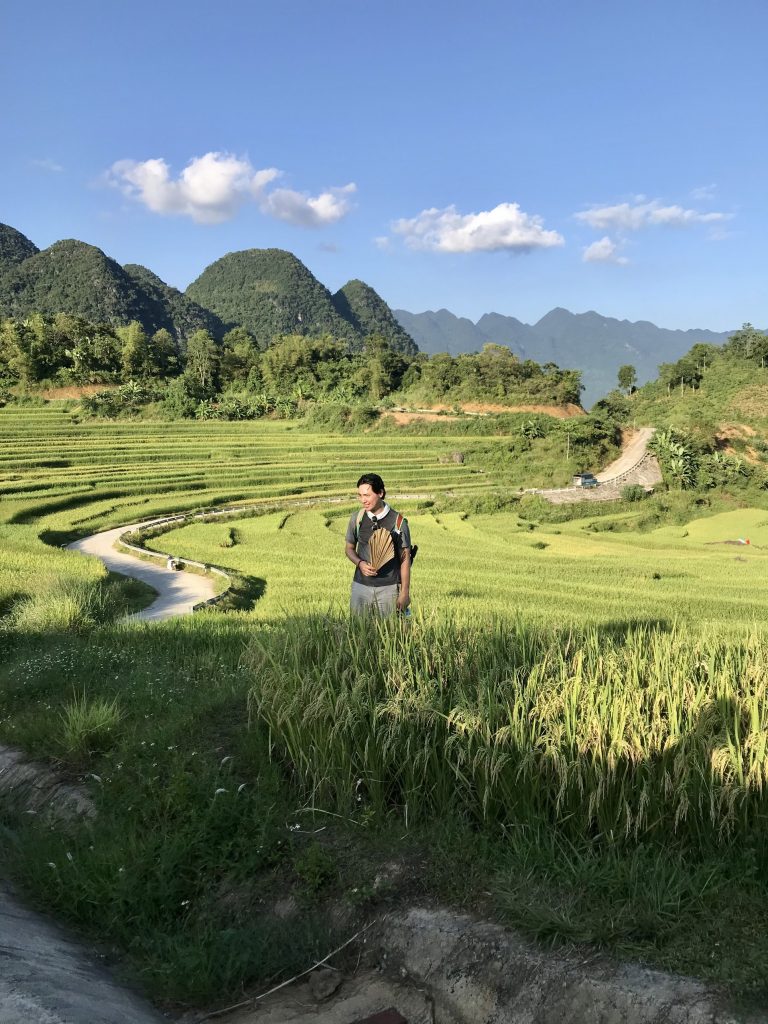
A few weeks after the seedlings are transplanted, the mirror surfaces disappear as the young rice plants grow and cover the water. The green that emerges from a freshly planted Pu Luong paddy is one of the most vivid and specific colours in the natural world — a bright, almost luminous yellow-green that intensifies as the plants establish.
By mid-April in the first cycle and through August and September in the second, this green has spread across the entire valley floor and up the hillsides. Combined with the darker, richer green of the primary forest and jungle on the mountain slopes above, the result is a landscape of layered greens — bright terraces below, dense canopy above, bamboo groves in between — that covers every hillside in the valley.
Trekking through this green season is a different experience from the mirror season, but equally rewarding in its own way. The trails are shaded and cool where they run through the forest. The paddies hum with insect life. The colours are so consistent and saturated that they almost feel unreal.
What You Will Do on a Pu Luong Rice Planting Season Trek
Trekking the Terrace Trails
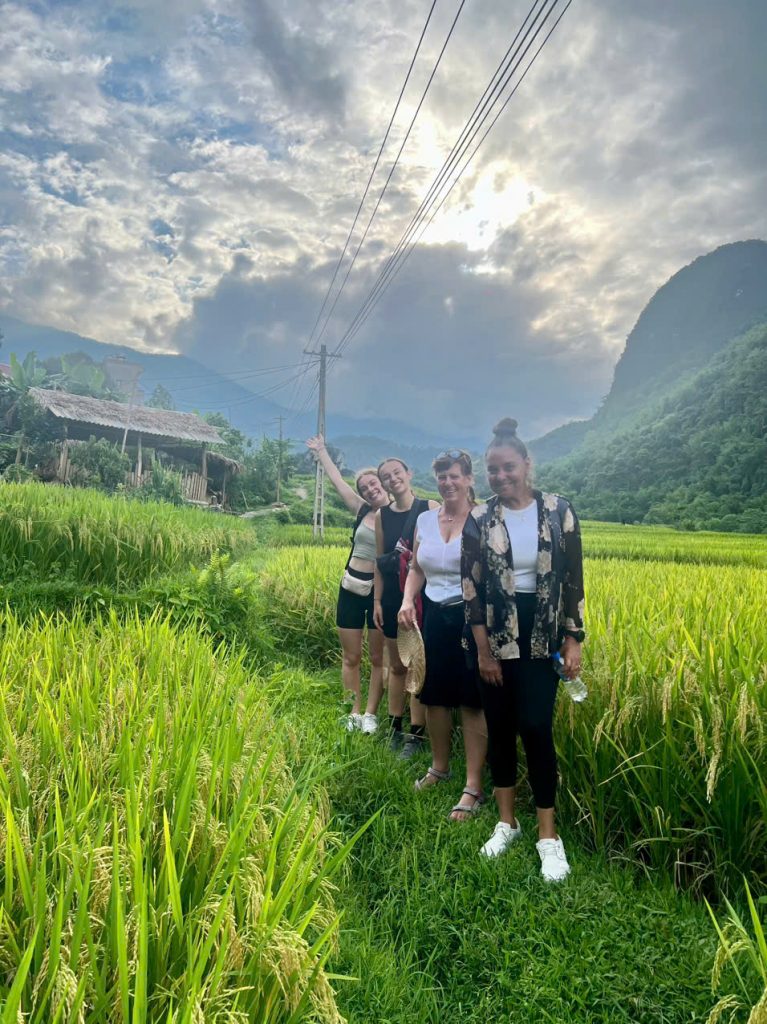
The core of a rice planting season trek in Pu Luong is walking — along the bund paths between paddies, up through village trails to higher viewpoints, and into the forest sections of the nature reserve that frame the farming landscape below.
The trails vary in difficulty. Some sections are flat and easy, running between fields on level ground. Others climb steeply up to viewpoints where the full scale of the terrace system becomes visible. Most full-day treks in Pu Luong involve five to seven hours of walking, with a mix of terrain that keeps the experience varied without being technically demanding.
Your local guide will choose a route based on the season, the conditions, and your group’s pace and interest. During the planting season, the best routes are the ones that combine the flooded field views at lower elevations with forest trekking at higher ones — giving you the full range of what the landscape looks like when it is working at full capacity.
Joining the Farmers in the Fields
One of the things that sets a rice planting season trek apart from a standard nature walk is the opportunity to participate in what you are walking through.
During the planting season, local farmers are out in the fields from early morning. With your guide’s help, you can introduce yourself to a family at work, watch how seedlings are bundled, sorted, and transplanted by hand into the flooded paddies, and — if the family is willing and the timing is right — try your hand at it.
Transplanting rice seedlings is not complicated, but it is harder than it looks. The water is cold. The mud grips your feet. The rows need to be roughly straight and evenly spaced, which experienced farmers do by feel after years of practice. Most visitors manage a few metres before their backs remind them that the farmers doing this all day deserve a great deal of respect.
It is one of those experiences that is both humbling and quietly joyful — the kind of thing you remember long after the trip itself fades.
Staying Overnight in a Village Homestay
The rice planting season trek is best done as an overnight experience, and the homestay is the reason.
After a full day on the trails and in the fields, you come back to a Thai or Muong stilt house, take off your muddy shoes at the bottom of the steps, and sit down to a meal prepared by the family. The food during planting season is particularly good — fresh, seasonal vegetables from the garden, sticky rice, and whatever protein the household has available. The conversations around the table, translated by your guide, tend to turn naturally to the rice — how the crop is looking, what the water levels have been like, whether the timing feels right this year.
In the evening, the valley settles into a quiet that is hard to find anywhere else. The sounds are insects and water and the occasional call of a bird. The air is cool. The flooded paddies below the house catch whatever moonlight is available and hold it steady in their mirrors.
It is a very good way to end a day.
What You Will Do on a Pu Luong Rice Planting Season Trek
Best Time for a Pu Luong Rice Planting Season Trek
The key windows for a rice planting season trek in Pu Luong are:
March to mid-April — the first crop planting cycle. Fields are flooded from March, creating the mirror effect. Seedlings are transplanted through mid-April. Daytime temperatures are pleasant at around 25°C, with cooler nights dropping to about 15°C. Weather can mix sunshine, fog, and light rain — which actually adds to the atmosphere of a flooded field landscape.
July — the second crop planting cycle. Fields are reflooded after the June harvest of the first crop and the brief fallow period that follows. July is warmer and more humid than March, but the mountain altitude keeps conditions manageable. The flooded terraces of July often have particularly dramatic mirror reflections because of the stronger light and the contrast with the surrounding green.
If your interest is in the growing green season rather than the flooded mirror period, target mid-April to mid-May (first crop) or August to September (second crop) — when the young rice is growing and the valley is at its most intensely green.
For the golden harvest experience, plan for mid-May to June or October to early November — when the terraces turn yellow-gold and farmers are out bringing in the crop.
The beauty of Pu Luong’s two-crop calendar is that there is almost never a wrong time to visit. But for a rice planting season trek specifically, March–April offers the most comfortable weather combined with the most dramatic flooded-field scenery.
Pu Luong Excursions: Farm-to-Trail Trekking in Northern Vietnam
Pu Luong Excursions is a licensed tour operator based in Pu Luong Nature Reserve, Thanh Hoa. We have been running trekking programs in this valley for years, and our Pu Luong rice planting season treks are among the experiences we are most proud of — because they connect visitors to the farming cycle that defines this landscape in a way that few other tours do.
Our local guides know the rice calendar intimately. They know which families are planting where and when, which trails give the best views of the flooded terraces at different times of day, and how to time a morning departure so you arrive at the best viewpoint just as the mist is lifting off the water.
Our rice planting season trek programs include:
- 2-day / 1-night introductory treks — a focused planting season experience combining the best terrace views, a farming participation session, and one night in a village homestay
- 3-day / 2-night full trekking programs — covering more ground across the valley, with a mix of terrace trails, forest sections, and deeper community interaction over two homestay nights
- Photography-focused trek packages — timed specifically for the best mirror-field light conditions, with early starts and guide knowledge of the best sunrise and sunset viewpoints
- Custom itineraries for couples, families, small groups, or solo travellers who want to build a rice planting experience around their specific travel dates
All programs include local guide fees, homestay accommodation, and meals. Transport from Hanoi or other starting points can be arranged as part of the booking.
A Pu Luong rice planting season trek is not a sightseeing trip. It is a walking experience through a working landscape, timed to a farming calendar that has been running in this valley for centuries.
The flooded terraces and the vivid green fields that follow are some of the most beautiful sights in northern Vietnam. But what makes this trek genuinely special is not just the scenery — it is the fact that the scenery is alive with people doing real work, in a place that has not been staged for tourists.
If you want to walk through that, Pu Luong Excursions is ready to take you.